8 Beautiful Animal Savanna Landscape: Africa's Wildlife in Vector Art
There’s something undeniably powerful about the African savanna—the golden light, the silhouettes of acacia trees, the quiet majesty of a giraffe moving through tall grass. Capturing that feeling in a design project can be tricky, especially when you need high-quality visuals that actually work across different formats and sizes. That’s where this collection comes in: eight distinct savanna landscape designs, each featuring wildlife and that unmistakable African atmosphere.
What Makes This Collection Stand Out
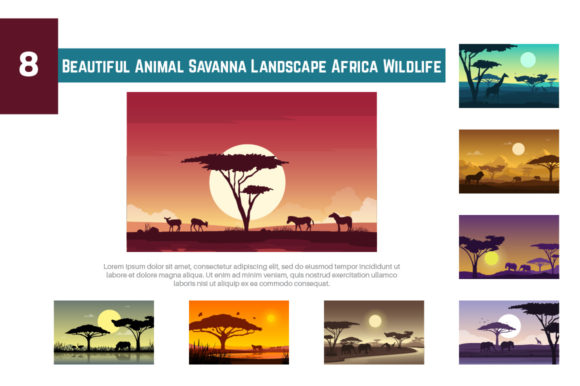
Each of the eight variations presents a different composition of savanna scenery. Think sweeping horizons, dramatic skies at dusk or dawn, elephants, zebras, lions, and antelope rendered with careful attention to natural posture and environment. The color palette leans into warm earth tones—burnt sienna, ochre, deep greens, and amber—paired with cooler twilight blues and purples in certain pieces. There’s a balance between detail and simplicity that makes these designs versatile: enough visual interest to hold attention, but not so much clutter that they overwhelm a layout.
The style sits comfortably between illustrative and painterly. These aren’t photorealistic renders, nor are they overly stylized cartoons. They occupy that middle ground where art meets practicality—detailed enough to feel premium, clean enough to work as background elements or focal points depending on your project’s needs. If you’ve ever struggled to find nature-themed design assets that don’t look generic or overly stock-photo-ish, this set addresses that gap directly.
Practical Applications Across Creative Projects
Let’s talk about where these designs actually make sense in real-world work. For brand identity projects—say you’re designing for an eco-tourism company, a wildlife conservation nonprofit, or a safari lodge—these landscapes can serve as hero imagery for websites, brochures, and social media headers. The vector format (EPS files) means you can scale them up for large-format printing on banners or trade show displays without losing sharpness. The 5000x3200 pixel JPEGs are more than sufficient for digital use, including web design backgrounds and social media graphics.
Publishers and bloggers working in the travel, nature, or lifestyle space will find these useful for editorial layouts. Imagine a magazine spread about African wildlife photography, a blog post about sustainable travel, or a book cover for a novel set in Kenya. The landscapes provide atmosphere without competing with text, which is a common challenge with nature imagery. Because each variation is saved as a separate file, you can pick exactly the right composition for each page or post without wrestling with cropping and exporting.
For packaging design, particularly in the artisanal or organic product space, these savanna scenes could complement product lines that emphasize natural ingredients, African heritage, or earthy aesthetics. A tea brand sourcing from East Africa, a skincare line using shea butter or marula oil, a candle company with “safari sunset” scents—these are the kinds of projects where the visual language of the savanna reinforces the product story.
Crafters and hobbyists shouldn’t overlook this either. If you create printable wall art, greeting cards, or custom stationery, having access to editable vector files gives you flexibility that flat JPEGs simply can’t. You can adjust colors to match a client’s palette, isolate specific elements, or combine pieces from different variations to create something entirely new.
Working With the Files: A Few Notes
The package keeps things straightforward. Each design comes in its own file, so there’s no guessing about layer organization or spending time separating compositions. If you’re comfortable with Adobe Illustrator, Affinity Designer, or similar vector editing software, you can open the EPS files and start customizing immediately. The JPEGs work out of the box for anyone who just needs high-resolution images without modification.
A couple of practical reminders: the mockups shown in previews aren’t included, so you’ll need to source your own presentation templates if you want to showcase the designs in context. And while the files are print-ready at their native resolution, always do a test print at actual size before committing to a large production run—especially for print design work where color accuracy matters.
When integrating these landscapes into a broader visual hierarchy, consider how they interact with your typography. If you’re using the savanna imagery as a background, pair it with clean, high-contrast typefaces—something like a modern sans serif font for body copy and a bold display font for headlines. The organic shapes and warm tones in the illustrations can clash with overly decorative script fonts or handwritten fonts, so test combinations carefully before finalizing.
Evaluating Fit for Your Specific Project
Not every project calls for savanna imagery, obviously. These designs work best when the visual narrative aligns with themes of nature, wildlife, adventure, earthiness, or African culture. If your brand identity is minimalist and urban, or your editorial design leans heavily into tech or fashion, these landscapes might feel disconnected. Context matters more than aesthetics alone.
That said, don’t be afraid to use them in unexpected ways. A fintech startup focused on investing in African markets could use a subtle savanna landscape in pitch deck backgrounds to reinforce geographic focus. A children’s educational publisher might adapt the wildlife illustrations for learning materials about ecosystems. The key is intentionality—knowing why you chose this particular imagery and how it supports your message.
For commercial use, review the licensing terms included in the package. Most premium font and design asset licenses cover standard commercial applications, but if you’re planning something unusual—mass-produced merchandise, for instance—confirm the terms allow it. When in doubt, the creator has noted they’re available for questions, which is worth taking advantage of rather than guessing.
Eight variations give you enough range to maintain visual consistency across a multi-piece project while keeping each piece feeling distinct. Use the same variation across a campaign for cohesion, or mix them to create a series with a unified aesthetic but individual character. Either approach works—what matters is that the savanna’s warmth and natural beauty come through in whatever you create.